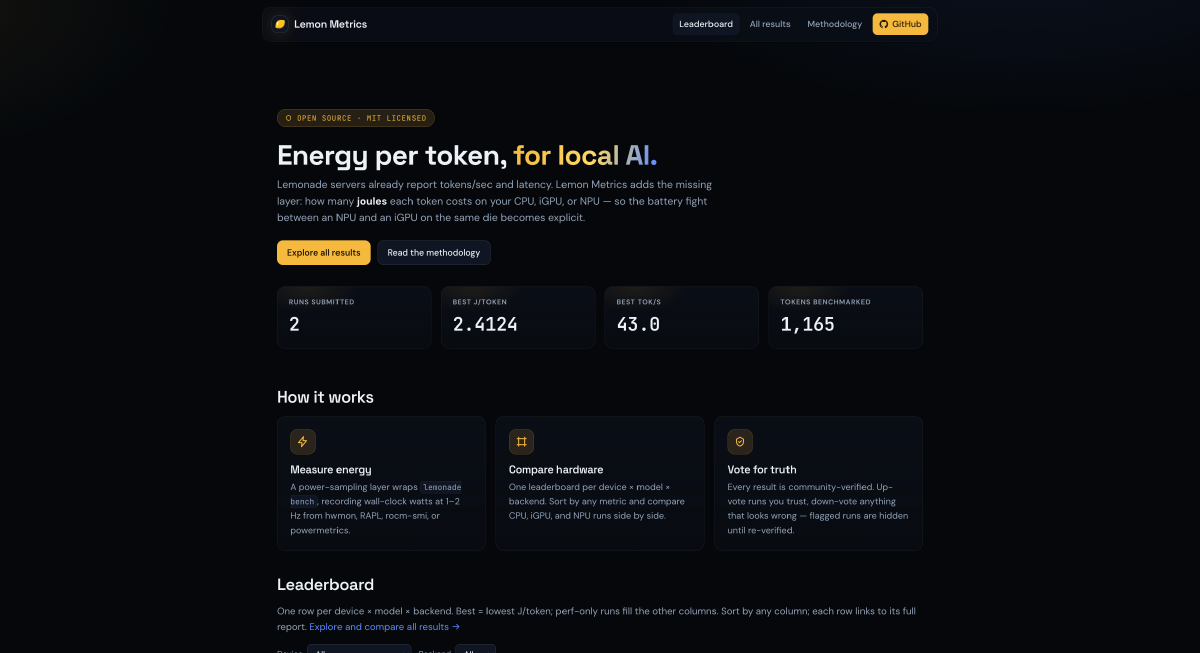

Introducing LemonMetrics: Energy-per-Token Benchmarking for Local AI
If you run local AI models, you’ve probably looked at tokens/sec. But speed alone misses the real question: how much energy are you spending per token?
That’s why I built LemonMetrics: an open-source benchmark harness for Lemonade that adds power sampling and reports metrics like:
- J/token
- J/output-token
- tokens/kWh
- wall energy, avg watts, and peak watts
Why this project exists
Most benchmarks focus on throughput. For real-world local AI usage, especially on laptops, efficiency matters just as much:
- Is a slightly slower backend actually better on battery?
- Which model/backend combination gives better work-per-joule?
- How do CPU, iGPU, and NPU compare when normalized by energy?
LemonMetrics makes those comparisons explicit and reproducible. This is not just useful for laptops, with the rising costs of energy, these metrics are becoming more important everyday.
What it does
- Wraps
lemonade bench --jsonso performance metrics come from Lemonade itself - Samples power during benchmark execution (platform-dependent)
- Measures idle baseline and reports baseline-corrected incremental estimates
- Stores raw artifacts for verification:
- report.json
- power.jsonl
- baseline.jsonl
- bench.json
- summary.md
- Gracefully degrades when power data isn’t available (run still completes)
Where to view results
Public leaderboard and community results:
https://LemonMetrics.github.io
Repositories
Core harness:
Results/site repository:
How to contribute benchmark results
- Run benchmarks on your machine (preferably on AC power).
- Commit generated result folders under data/results/….
- Open a PR in the site repo.
- CI validates schema and integrity before merge.
Run guide:
https://github.com/lemonmetrics/lemonmetrics/blob/main/docs/run-it-yourself.md
Methodology (how metrics are computed):
https://github.com/lemonmetrics/lemonmetrics/blob/main/docs/methodology.md
Data honesty pledge
The project is strict about data integrity:
- No fabricated power numbers
- Raw benchmark and power artifacts are preserved
- Schema validation is required
- If power can’t be measured reliably on a platform, results are marked unavailable instead of guessed
Looking for contributors
If you have different hardware (especially diverse CPU/iGPU/NPU devices), your submissions help build a more useful, transparent efficiency leaderboard for everyone.